
EV Charger Installation Coventry | Home Charging £79
A home EV charge point is a dedicated high-current circuit that must be designed for safe continuous load. Incorrect cable sizing, earthing issues, or limited spare capacity can cause overheating or nuisance tripping. We assess the existing supply, protective devices, and load profile. This confirms whether the installation can meet current safety standards.
The practical solution is a professionally installed charger with verified protection and tested fault disconnection times. For EV Charger Installation Coventry, we calculate maximum demand and select suitable RCD and surge protection. Our Electrician Coventry inspections confirm earthing arrangements and certificate compliance. The technical evaluation can be structured efficiently with Electrician Coventry.
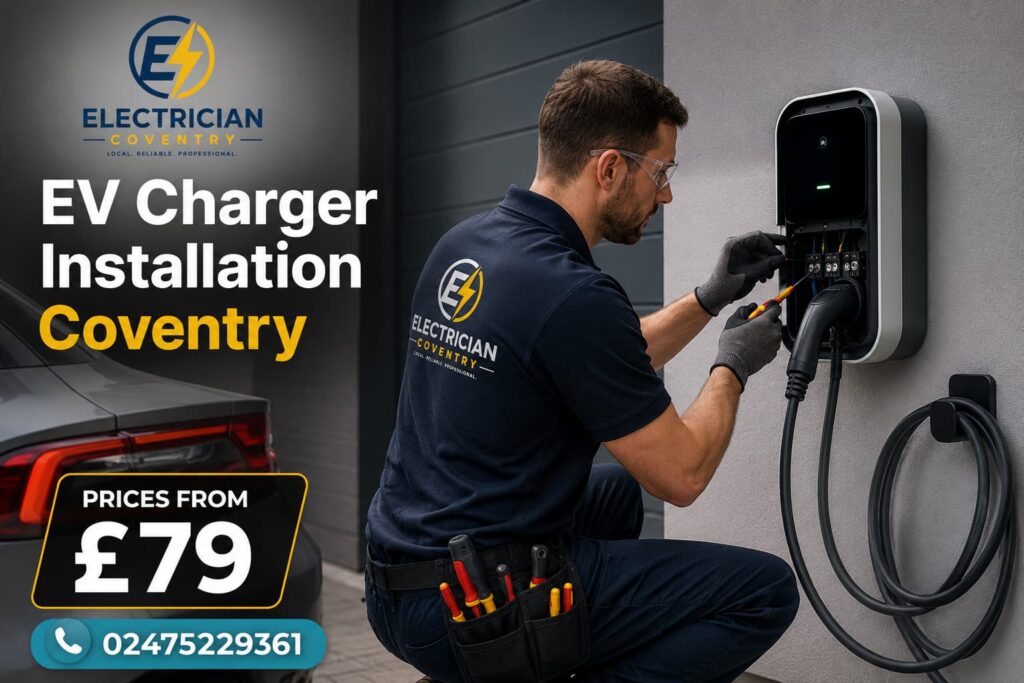
EV Charging Point Installation Coventry
Professional EV charging point installation services for homes and businesses in Coventry. We supply and install smart electric vehicle chargers that are safe, efficient, and fully compliant with current regulations, helping you charge your vehicle quickly and reliably at home or work.
How does EV Charger Installation Coventry work for homeowners in Coventry?
EV Charging Point Installation Coventry for a typical home means adding a dedicated, high-current circuit that can supply an EV safely for several hours without overheating cables or stressing protective devices. The work is not just “fitting a box”; it is designing the circuit around your supply, earthing arrangement, and spare capacity so the charger can run reliably.
We start by classifying your supply type and earthing (the method your electrics use to clear faults quickly), then we check whether the consumer unit has suitable protective devices and free ways. Cable size, route length, and installation method matter because heat build-up is linked to how a cable is enclosed and how long it carries load.
Once the electrical design is confirmed, the charger is installed, tested for correct fault disconnection times, and documented so it remains compliant with standards. If you want us to confirm what your property can support before choosing hardware, book a site survey with our Electrician Coventry team.
What a qualified home charge point installation typically covers
A qualified installation includes electrical design, safe connection, protection selection, verification testing, and certification, not just mounting and cabling. A compliant job proves the circuit can disconnect a fault quickly and that the charger cannot place dangerous voltage on exposed metalwork during a fault.
For home ev charger installation, we normally include a supply assessment, selection of protective devices (such as the correct RCD type for the charger’s leakage characteristics), a local isolator where appropriate, and a cable route that protects against mechanical damage. We also confirm bonding and earthing so fault current has a low-resistance path back to the supply.
Testing is the part homeowners never see but rely on: insulation resistance, polarity, earth fault loop impedance, and RCD trip performance. If you want EV Charging Point Installation Coventry completed with measured results and formal certification rather than assumptions, ask us to scope the work to your exact consumer unit and cable route.
EV Charger Installation Coventry: charger types and everyday advantages
Most domestic charging in Coventry is best described as “Mode 3 AC charging”, where a wall-mounted charge point communicates with the vehicle and limits current to a safe level. This arrangement is electrically safer than using a socket because the charger includes control and protection functions designed for continuous load.
- Basic (non-smart) chargers provide a fixed maximum current and are suitable where the supply is simple and there is no need for scheduling.
- Smart chargers add timed charging and app control, helping align charging with off-peak tariffs without changing the electrical fundamentals.
- Load-managed chargers monitor household demand and reduce EV current to avoid overloading the main supply.
- Solar-aware chargers can follow available generation, but still need correct earthing and protective coordination.
Choosing between these types affects how we design EV Charger Fitting Coventry around monitoring, isolation, and future proofing, so it is worth discussing options before purchase—contact us for a recommendation based on your supply and driving pattern.
Picking the best charger rating, connector type, and smart controls
The “best” charger is the one whose current rating matches your supply headroom, cable route limits, and how quickly you realistically need to replenish miles overnight. In most homes, 7.4 kW (32 A single-phase) is a practical upper limit, but only if maximum demand calculations show the rest of the property can run safely alongside it.
Connector choice is usually Type 2 for UK domestic charging, but your decision between tethered and untethered affects day-to-day handling rather than circuit design. Smart controls should be judged by what they measure: genuine load management uses a current sensor on the incoming tails so the charger can back off before the main fuse is stressed.
A clear way to compare choices is to request an EV Charger Installation Coventry quote that lists the assumed charger current, cable length, and the protective devices included, because those items determine both safety and long-term reliability. If you share your consumer unit photos and the preferred charger location, we can advise what rating and controls are electrically sensible before you commit to hardware.
Tethered vs untethered chargers, and what “rapid” really means at home
Tethered chargers have a permanently attached lead, while untethered chargers use a socket on the unit and a separate cable, and the difference is mainly usability rather than electrical capacity. “Rapid” charging is a DC public-network term; at home, the limiting factor is the property’s supply and the charger’s AC rating, not the marketing label.
|
Option |
What it changes electrically |
What it changes day-to-day |
|
Tethered |
Little; same circuit and protection requirements |
Fast plug-in, cable is always present outdoors |
|
Untethered |
Little; same current and earthing considerations |
Neater appearance, you store and carry the cable |
|
“Rapid” at home |
Not applicable beyond your AC supply limit |
Charging time depends on kW and battery state |
If you are comparing level EV Charger Installation near me options, the meaningful question is whether your supply can support the current continuously without nuisance tripping or overheating—contact us and we will confirm the practical limit for your property.
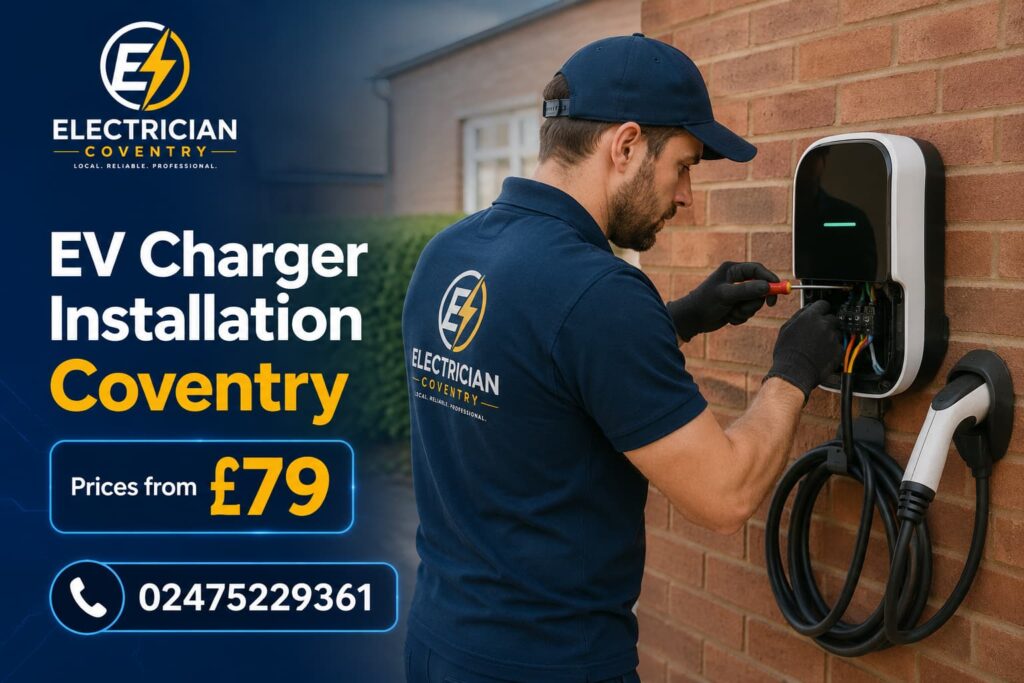
EV Charger Installer in :contentReference[oaicite:0]{index=0} – Professional EV Charging Installation Services
Recent installations across Coventry and what homeowners chose
Across Coventry, the most common choice is a 32 A smart charger with load management, because many homes have enough overnight capacity but limited spare headroom at peak times. This configuration reduces the likelihood of the main cut-out fuse being pushed close to its limit when cooking, heating, and charging overlap.
Older properties often need more time spent on earthing and bonding verification, because an EV Charger Installation Coventry is a high-demand appliance that makes marginal connections show up as heat or voltage drop. Newer estates more often have straightforward cable routes and modern consumer units, but we still verify that protective device types match the charger manufacturer’s requirements.
When homeowners search ev charger installation near me, the important comparison is not brand preference but whether the installer is checking supply limits, measuring loop impedance, and documenting results. If you want to understand what specification is typical for homes like yours in Coventry before booking, speak to us and we will outline the practical options for your street and property type.
Step-by-step: from site survey to testing and handover
A safe installation follows a defined sequence: assessment, design, installation, verification, and documentation, with each stage preventing a different failure mode. Skipping the survey or the testing is how overheated cables, incorrect RCD selection, and unreliable charging behaviour happen later.
- Site survey to confirm supply type, earthing, consumer unit capacity, and cable route constraints.
- Circuit design to select cable size, protective devices, and any load management required.
- Installation of charger, isolator, cabling, and terminations with correct mechanical protection.
- Electrical testing including polarity, insulation resistance, loop impedance, and RCD performance.
- Handover with certification and settings confirmed for safe everyday use.
This is the workflow we use for EV Charger Installation Coventry because it produces measured proof of safety rather than opinions, so if you need an installation planned around a specific parking arrangement and cable route, book a survey with us.
Cabling routes, permissions, and when a consumer unit upgrade is needed
The cable route is often the deciding factor in installation complexity because it affects voltage drop, heat dissipation, and the risk of physical damage. A longer or more enclosed route may require a larger cable to keep resistance low and temperatures stable during long charging sessions.
Permissions can matter when cabling crosses shared areas, when drilling affects fire barriers, or when the charger position creates trip hazards in communal access routes. Inside the property, a consumer unit upgrade becomes necessary when there is no spare capacity for an additional high-load circuit, when existing protective devices cannot provide the required RCD characteristics, or when the unit cannot accept surge protection where it is needed.
If you are comparing ev charger installation companies, ask whether they assess cable routing and consumer unit limitations before quoting, because these items determine whether the finished EV Charger Installer Coventry is both compliant and long-term reliable—contact us and we will confirm what upgrades, if any, are actually required.
Who does what: homeowner, installer, and the network operator
Responsibility is split: the homeowner decides location and access, the installer designs and certifies the new circuit, and the network operator remains responsible for the incoming supply equipment and main service fuse. Knowing this boundary prevents delays and avoids unsafe work on sealed or live supply components.
We handle the electrical design, installation, and verification, including ensuring earthing and bonding are correct for a high-load EV circuit. If the property supply is marginal, we may recommend load management or, in some cases, discussing supply capacity with the network operator, but we do not interfere with sealed cut-out equipment.
Formal paperwork matters because it provides traceability for future electrical work and helps ensure the charger remains electrically safe after alterations. If you need an ev charger installer who can coordinate the technical responsibilities and provide compliant certification for EV Charger Installer Coventry, get in touch and we will explain what each party must do before work starts.
EV Charger Installation Coventry: how to compare installers and quotes
A good comparison is based on what is being designed and tested, not just the hardware brand or the headline price. A quote that names cable type and size, protective device specifications, testing scope, and certification is typically more reliable than one that only lists “install charger”.
Look for clear commitment to verification testing and documentation, because those steps confirm fault disconnection and safe operation under continuous load. If a provider is offering an ev charger installation electrician near me service, you should still check whether they are accounting for earthing type, maximum demand, and the charger’s required RCD characteristics, since EV equipment can influence protective device selection.
Contract clarity matters as well: an ev charger installation contract should state what is included if remedial work is discovered, how cable routing changes are handled, and what certification will be issued at completion. If you want us to review a quotation line-by-line and explain what it implies electrically for EV Charger Installer Coventry, send it over and we will highlight what is missing or unclear.
EV Charging Installation Service Coventry
Expert EV charging installation services in Coventry for residential and commercial properties. We install high-quality electric vehicle charging systems designed for safety, speed, and efficiency, ensuring a seamless charging experience tailored to your needs.
FAQ about EV Charger Installation
What steps are involved in a safe EV Charger Installation Coventry ?
Safe installation follows survey, circuit design, fitting, and full electrical testing. We confirm earthing, cable sizing, and protective devices so fault current disconnects fast. We also verify RCD performance to meet UK standards. Book our team to survey and certify.
How quickly can an urgent EV charger installation be scheduled?
Urgent work can often be scheduled within 2–5 working days if the supply and access are straightforward. Delays usually come from longer cabling routes or limited consumer unit space. We prioritise jobs once we confirm load capacity and parts. Contact us with photos to triage.
Which home electrical upgrades are needed before installing an EV charger?
Upgrades are needed when the consumer unit lacks spare capacity or modern protection, and costs typically start from £250 for basic remedial work. High continuous current can expose weak terminations and undersized cabling. We check maximum demand and decide if new ways, SPD, or tails are required. Ask us to assess your board safely.
Who is responsible for permits and compliance during EV charger installation?
Compliance is our responsibility for the new electrical circuit, while the network operator controls the sealed supply equipment. EV Charger Fitting Coventry must be designed to match the earthing system and proven by test results. We issue certification and handle notifications where required. Arrange a survey so we can confirm the correct route.
Is workmanship guaranteed after EV Charger Installation Coventry is completed?
Workmanship is guaranteed when installation is professionally installed and documented with test readings. Reliability depends on correct torque at terminations and stable voltage under load. We provide certification and can return to re-test if you change the charger settings or vehicle. Speak to us to confirm guarantee terms in writing.
A home charge point should operate as a dedicated, continuously rated circuit with predictable protection and stable voltage under load. Correct selection of earthing measures, RCD type, cable sizing, and isolation keeps fault disconnection reliable and limits thermal stress. EV Charger Fitting Coventry is technically sound when it is verified by measured test results and documented certification. For a final assessment of suitability and compliance, arrange a structured evaluation with Electrician Coventry.